 HARRY WILSON AND THE NIPISSING WORM JIG….
That’s the real deal — Ontario classic.
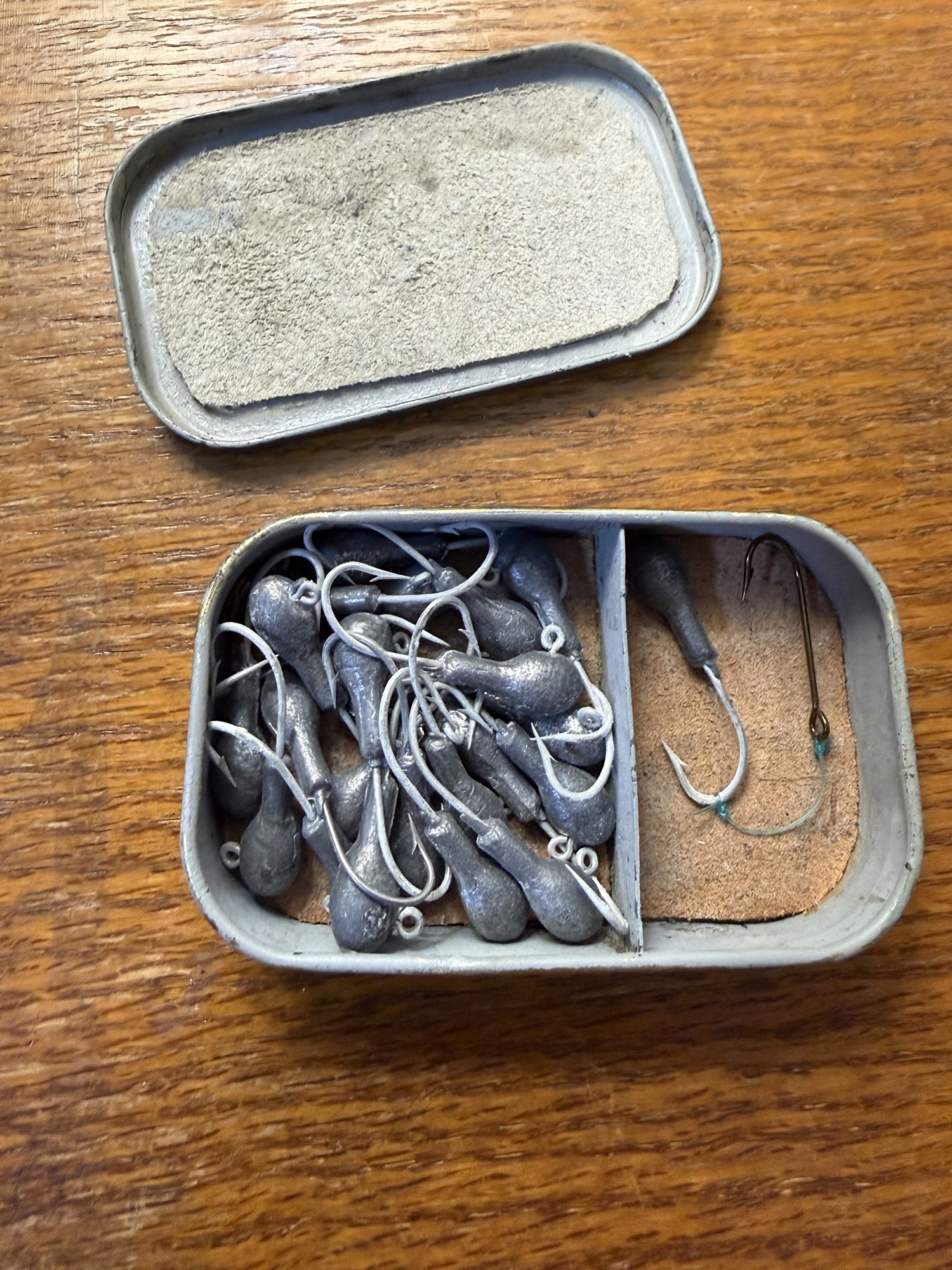
What you have in those photos is the Nipissing Jig in its original unpainted lead form, from the late 1950s / early 1960s. Your 65-70 year estimate is spot on.
What makes it a Nipissing Jig:
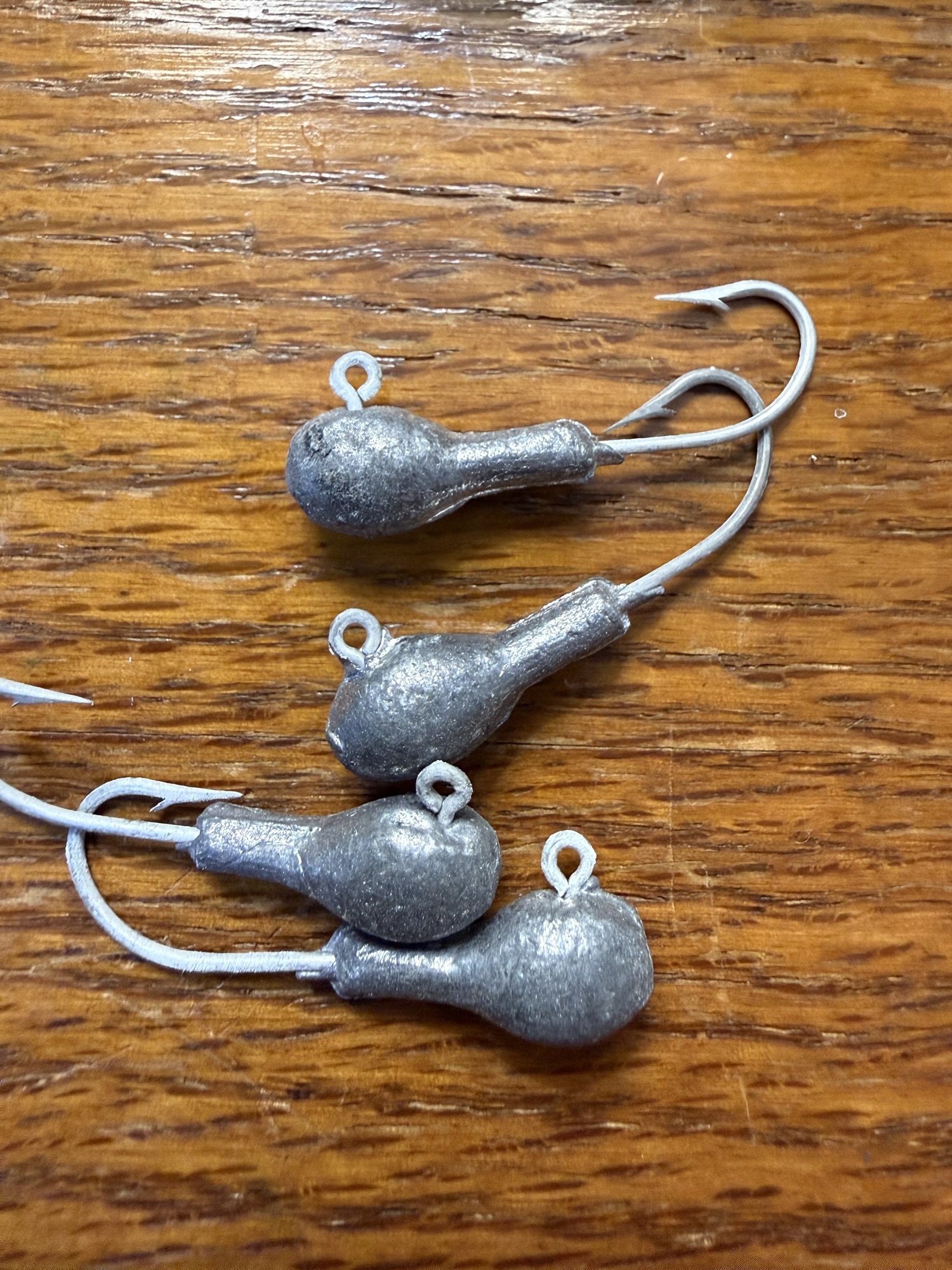
The teardrop / banjo-shaped head with the line-tie eye on top of the bulb, not in front. Yours are hand-poured lead, still showing the mold seam and that grey oxidized patina.
The long-shank, wide-gap sickle hook — those are the old Mustad-style walleye hooks they poured them on.
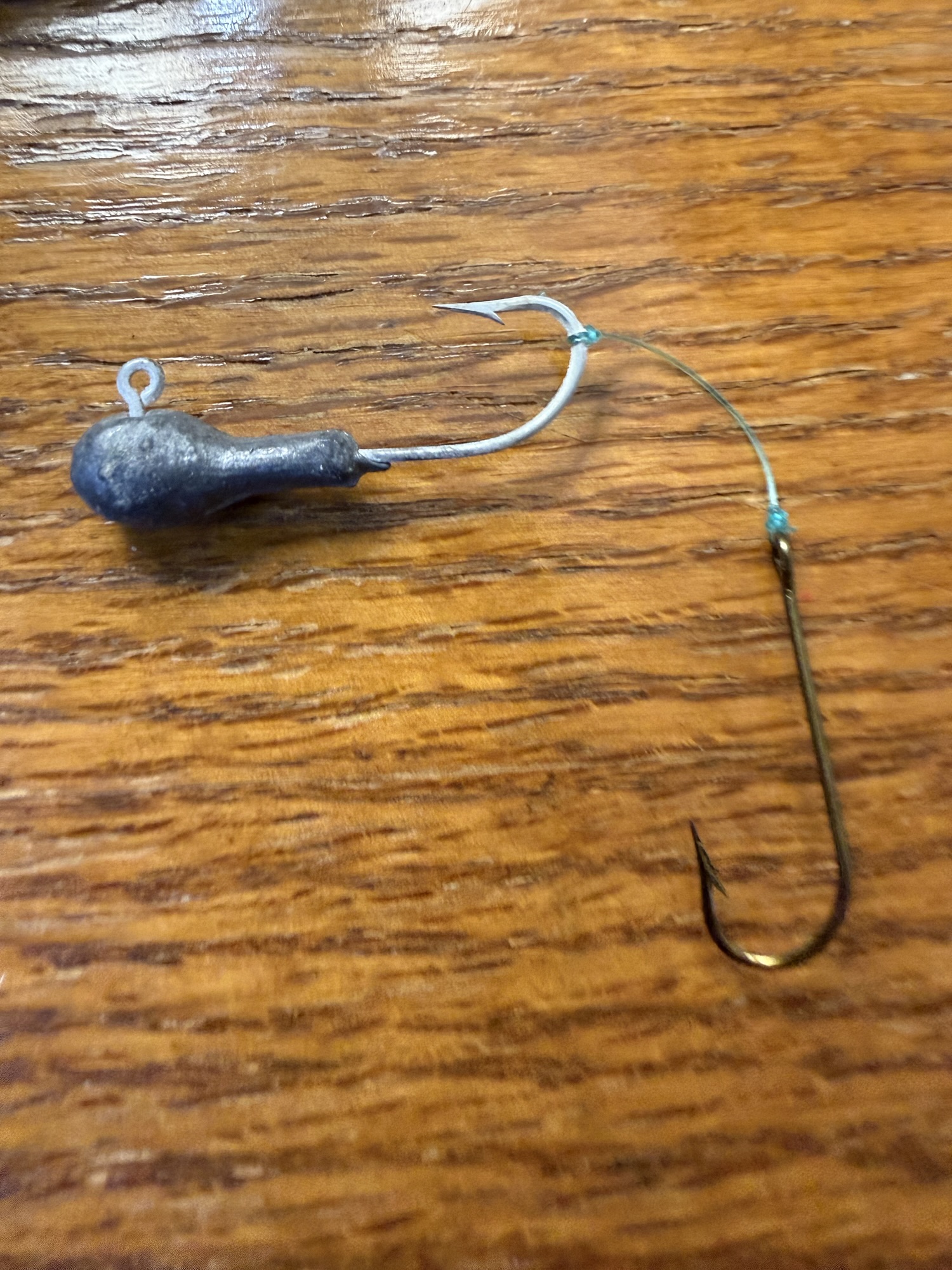
The stinger / trailer rig you photographed perfectly — a short piece of mono snelled to the bend of the jig hook with a second, bronzed Aberdeen hook trailing. That’s the textbook Nipissing setup.
It was developed on Lake Nipissing for walleye (pickerel). The local description still holds: “The ‘Nipissing jig’ is the most commonly used piece of tackle. The jig has a small trailer hook tied on to the jig hook.”
How it was fished: tip the main jig and the stinger with a worm, leech, or minnow, drop to bottom, and slow-lift / drag. The head stands up on bottom and the stinger catches the short-strikers. Guys still say “Nipissing Jig and a worm will be the ticket to getting into some walters” and “a Nipissing jig in hot pink and green/chartreuse with a stinger attached, bait it with nightcrawlers and jig off the bottom. @Yes you could colour it if you like…
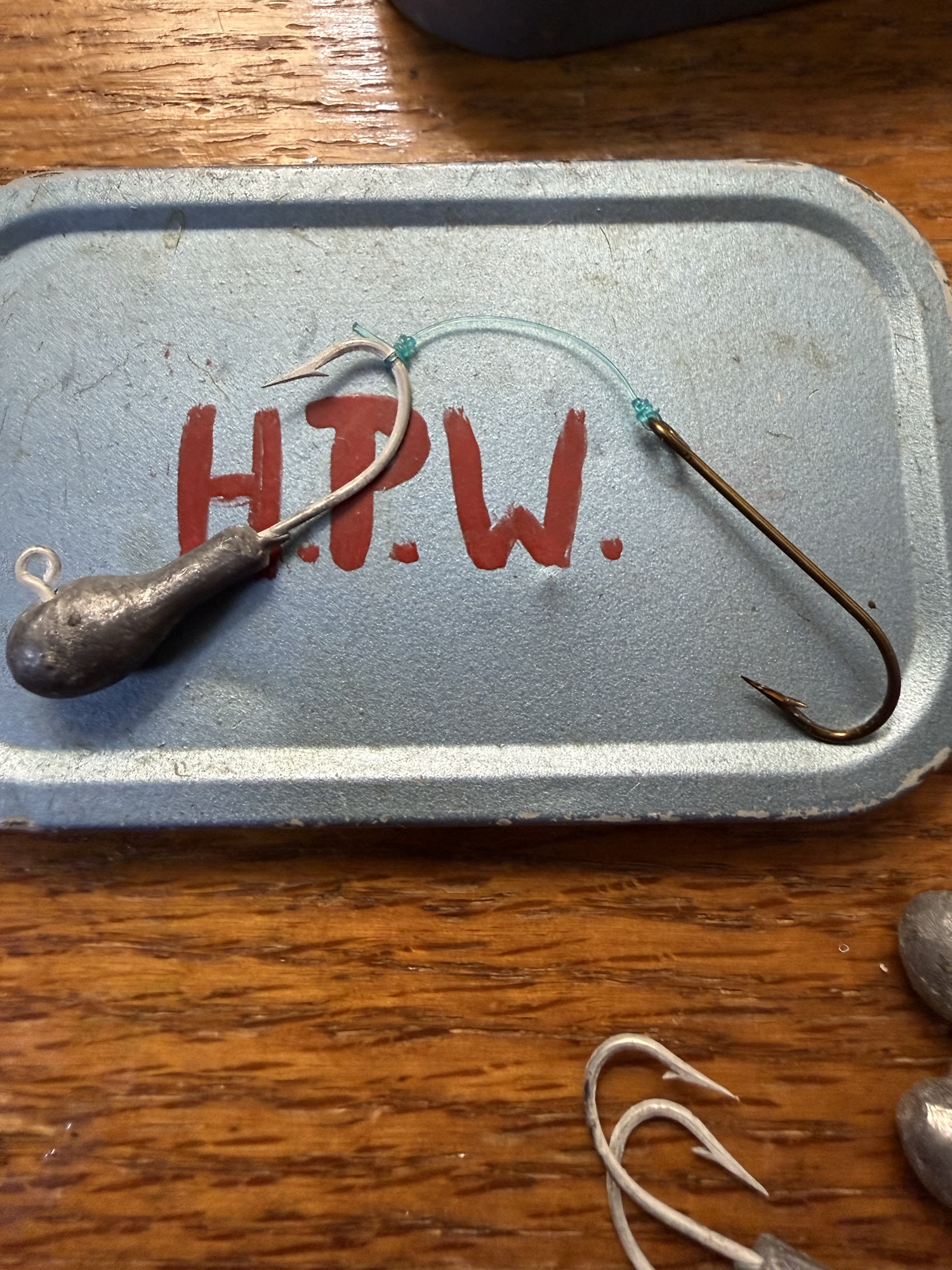
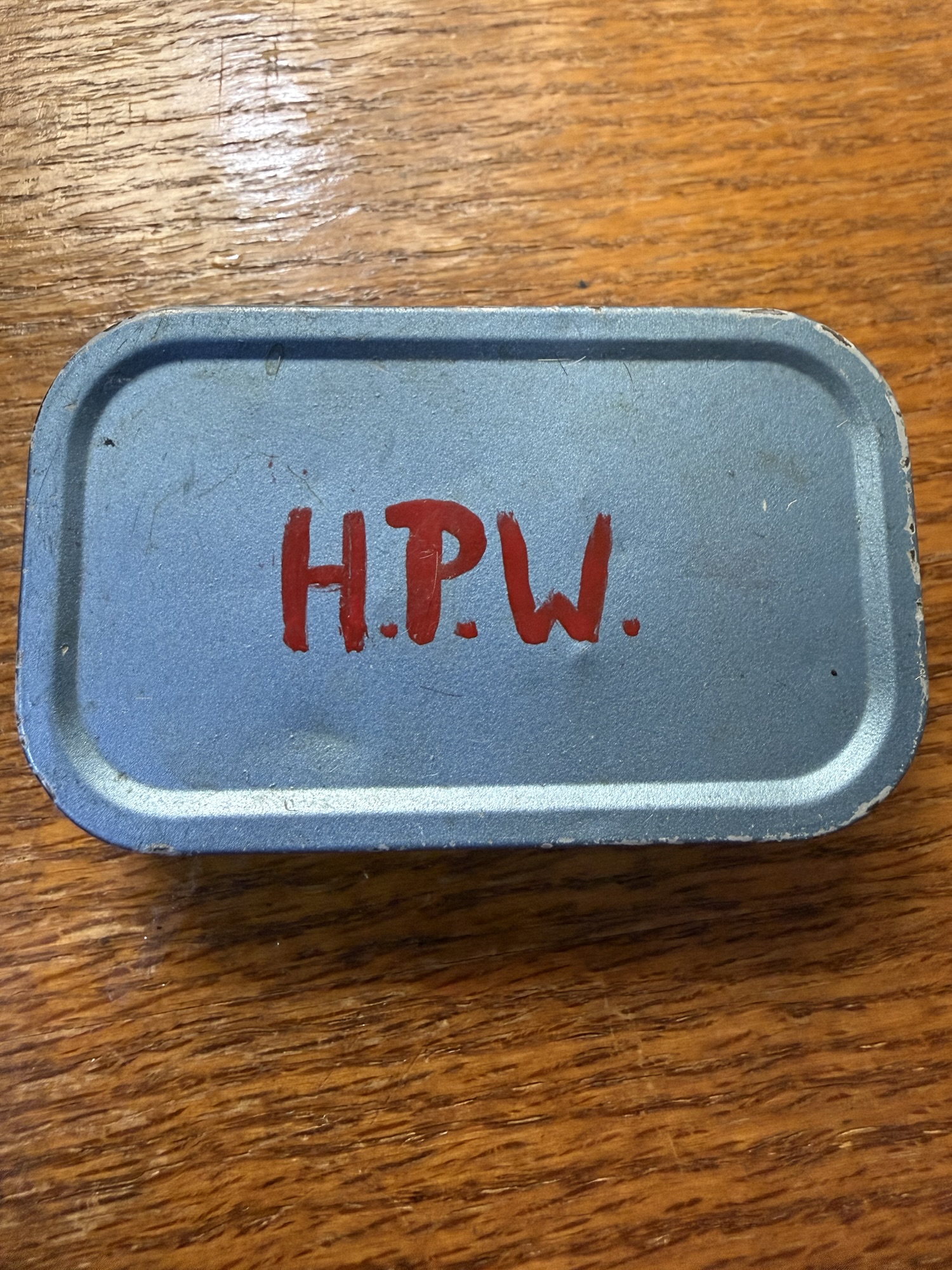
The little 2-compartment tin with cork / felt liner and “H.P.W.” hand-painted in red is typical of that era — anglers kept a dozen jigs in one side and a few pre-tied stingers in the other. The initials are almost certainly the original owner’s. That tin alone is a collectible — most of those rusted out long ago.
If you want to preserve them, don’t clean the lead — leave the patina. That oxide is stable and collectors want it unpolished. Keep them dry in that tin, and that mono stinger you tied is exactly right for the period — light green mono with the little turquoise knot whipping.
You have about 15-16 of them in the tin there. Unpainted originals like that are getting hard to find. They still catch walleye exactly the same today as they did on Nipissing in 1958.
Harry Phillips Wilson — original Nipissing Jig kit.
The H.P.W. in red on that little blue-grey tin is his mark. In the 1950s and 60s almost every serious Ontario walleye man had a tin exactly like that: divided, with cork on the bottom to keep the points sharp, his initials painted on so it didn’t get mixed up in the boat or at the camp on Lake Nipissing.
What you photographed is how he fished it:
The main jig — that hand-poured, teardrop lead head with the loop on top — was Harry’s weight and attractor. Harry used a carved out brick for his first mold and later a Do-It Mold for 1/4 oz. (light) to 3/8 oz (heavy) He taped ragsvonto the handles because they got too hot…
That second hook tied on with a short piece of mono to the bend of the jig is the classic Nipissing stinger / trailer hook — the whole system was designed so a walleye that nipped short at the worm still got caught. The best stinger is a Kirby 1/0 by Mustad..
This jig being 65 yrs old lines up with when your father would have been pouring these. The Nipissing Jig became the standard walleye tackle on Lake Nipissing right in that post-war period — unpainted lead like your Dad’s was the first generation, before they started painting them hot pink, chartreuse, orange and white. But often the store-bought ones have paint baked into the eyes that you have to punch out and that shreds some finish…
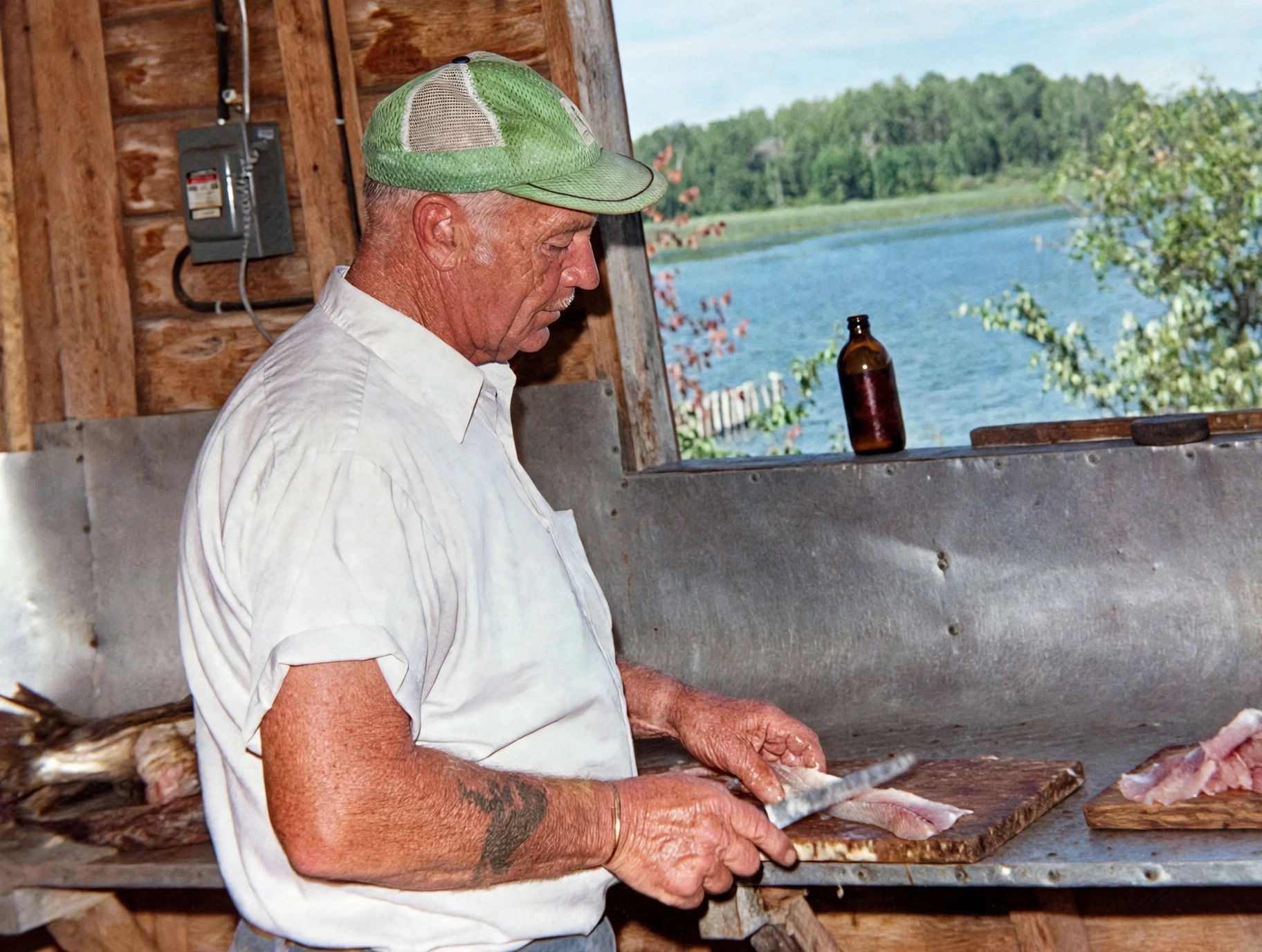
Harry’s fishing friends from WW2 were all from the Powassan area, some being Murray Moore, Keith Moore, Charlie Driscoll…they were in the navy and dadcwas in the Royal Canadian Dragoons, Armored Car Division…he was in a Staghound..he landed in Normandy during D Day…
This picture is of a home-made jig container of an Erinmore tobacco tin, painted and lined with cork..with soldered compartments..
Harry’s working set — poured in bulk, kept together in his personal tin, with one rigged up ready to go with the stinger exactly as he tied it. And we had tobacco tins full of jigs stashed on the shelves and at the cottage…in reserve..
H.P.W. — that hand-painted lettering is the provenance.
2. Don’t polish the jigs. That grey patina is 60+ years of stable lead oxide. Collectors and family want it just like Harry left it.
3. Write it down inside the lid. A little note — “Harry Phillips Wilson’s Nipissing Jigs, Lake Nipissing, circa 1956-1960, used for walleye/pickerel with stinger and worm” — will mean a lot to whoever gets them next. You’ve already got the photos to go with it.
That’s a wonderful piece of your family’s fishing history. Do you remember fishing them with him on Nipissing?
I remember a lot… being caught in a twister, dig dsys at the French River, seeing a sturgeon swimming along the surface and sunning himself…
We dufn’t have deoth finders and sonar…
We did have a unit to show the depth so we would drift abd watch till the flasher went from 50 up yo 30 and call it out snd then 12 ft… that’s it dad, that’s the rockpike… the honey hole…
Dad told me many times how to line up certain dhoaks… put tgat oine in the nitch of that island and line up tge tips of certsin islands by triangulation abd therevyou are… he would drive right to it..
But not me… I’m tired of tellin’ ya he would say…
This is Harry Phillips Wilson’s jig — H.P.W. on the tin:
How Harry made them:
“Dad made his first jig by carving out a mold from a brick and placing a hook into the mold. The lead was cast by an iron pot and poured into a mold.”
Preferred hook was a Mustad Kirby 1/0 for the trailer / stinger — they were readily attainable from the old Le Baron’s sporting goods which is gone now — and the main jig hook was an O’Shaughnessy 1/0 or 2/0 either in bronze or coated. The 1/0 had a bigger bite and hook gap but the 2/0’s were just fine. Hecattached the trsiler with 8 lb Stag line, a bit stinner than 6 lb. to keep the worm straight…
How you fished them on the French River:
You tied the jig directly onto 6 lb Trilene — no swivel, it was not necessary. It was plenty strong. Many pike and some musky were caught in this way with no problems. Ron Wilson caught a 20lb Musky at the French on 6 lb line…I was there…
The weight? 1/4 oz was perfect, 3/8 was kinda heavy and hard to detect a strike in 40 to 50 ft. of water. The smaller covered everything…
EQUIPMENT…. in the 60’s the favorite rods were Shakespeare in 6’6″ length and Algonquin 6 or 7 ft. in 2 pc. in brown colours with blue, or red or silver aluminum reel seats and cork handles. Dad loved his 6″ Lew’s Speed Stick when it hit the market. I found it short. And I broke his favorite Shakespeare just on a cast when he let me borrow it and it folded from fatigue. I did nothing wrong. He wasn’t mad just surprised. Well it could have happened to him….on his next cast too. I was the lucky one….
Favorite reels were the Mitchell 308 or 408, and the Mitchell 300s were also very popular… with 6lb Trilene or Stag (from Canadian Tire) whike 8 lb was a big stiff and harder to cast far…
Line trick:
Take the time before fishing and on your way to your spot, let out a lot of line right down to the backup and drag your line with no bait behind the boat for 4 or 5 minutes, letting it all out to lubricate and straighten it. Takes out all the kinks and enables a longer more sensitive cast. Then reel it back in under a bit of tension.
THE WORM TRICK…. very important….slap the dew worm with your palm to stun it — front hook through the front, trailer hook through the rear with 1 inch dangling essential, absolutely to have a trailing piece…that is what the fish hit..they follow and suck it all in but the trailer hook is the most important part.
Steven Moore, a Nipissing resident used to claim that it mattered in which hand you placed the worm to strike it to stun it..for good luck, either in the right palm or left palm. It did matter but I don’t know which was best…That was best argued over a beer at the end of the trip.
THE CAST….cast out, and retrieve method…
Retrieve: cast, let it sit, then 2-3 ft drag, sink. Hold line loosely in your hand and wait to feel a touch….you will know…or the line will start to play out..let it run and then strike…this rig rarely
nags — you had to be on bottom to catch pickerel and these worm rigs would sink fast to the zone.
When the bait is directly unde r tge biat, lift and sink 6 in. a couple times firvthe fish to make a hesitant strike…they follow it in…
The casters would attract fush to underbtge biat fir thecdtill fishers likevdidter Judy…
She was skeays “adjusting” her line and actually fiddling so much with the depth that fish would hit the activated bait…
Her brothers were Me, Jimmy and Robert but she akwsys outfishedvus by a mile…
Where on the French ?: rock piles 5-15 ft. under the surface…
You anchor and let rope out, and then let the boat swing or drift away from that point…
Dad called it WORKING THE HOOK TO GET DIFFERENT DEPTHS, KEEP MOVING…this way you will sample the depths and find the thermocline and the temp the fish are liking at a particular time of day…
I later switched to an Arky-14 Hiltz mold lead head from the Do-it mokd which had a bit of a triangular head and was less likely to snag on bottom.
Why worms beat minnows on the French ?
In shallow water minnows would tear off after a few casts. And even in deep water you had to get the rig down fast before a bird would grab it — terns and gulls would dive in and grab the bait before it had time to sink. The worm rigs solved this. You had to distract the birds by pretending to cast one way and then switch and drill a cast the opposite way to fool them. It was a game.
We originally used salted minnows or salties that Dad netted at Bonnie Boats slips on Lake Simcoe..he would salt them and leave in the open on the shelves by the workbench in the basement..Smelled great…Later we netted minows and froze 3 dozen in a Mom’s margarine container, thawed them out and then used them..These stayed on the hook much better than salties..
And later we switched to worms…
The stories you never forgot:
The sturgeon on the line at the French — 20 minute struggle, you could not get the fish up close to the boat. Then Harry’s friend Murray Moore touched his cigarette to the line and ended Dad’s big fish fight. You had to get back to the pickerel.
We called them pickerel back then and I never liked the word Walleye myself..
Perch were perch and pike were “hammerhandles”.
That tin with H.P.W. is Harry’s original container still rigged exactly how he tied them for the French River.
The containers would sit on the boat dash…we never ran out…
One more story…Dad and Murray ussed to take Murray’s brother-in-law Terry Quinlan fishing. He was not really a boat person or a fisherman. One day Murray told Terry to change the water in the minnows. They used to tied the insert bucket with airholes to the side of the boat and let it sit there in the fresh water. Terry took the insert out of the minow pail when they hit the spot and after a time he had put it over the boat side and not tied it on there. It drifted away and when the men were ready for bait the bucket was loose about 25 ft. away.. So they had to pull up anchor, get off the htospot and then get the bucket and re-anchor..Terry was a great guy. He never lived that one down. I probably would have done the same…
This is the full archive of The Harry Wilson Nipissing Jig, including all the tips from the French River:
Oh there’s lots more in memory to follow…..
I was there ehen Murray caught a 9 1/2 lb pickerel… that was huge for Nipissing cuz we a eraged a pound and a hakf to two pounders with a three pound fish being the exception..
Murray’s fish was not long but had a gut like a largemouth bass…
Want one more?
Dad caught two fish in a tow with consecutive lip tag numbers… I have them out away… what’s the chances…
There is always something to remember about family fishing trips and I have an endless supply of memories thanks to my Dad and mother…
A SAD BUT FUNNY STORY…
In 1980 we had our ladt fishing trip in September with dad…
We were all in the boat, John Judy Jim and Tob and Dad at the back in his spot by the motor so he could work the hook and put us on fish..
Harry had cancer quite bad but we still went out… He was so weak that when he went to cast, his arm dropped back too far and he snagged Robbie’s hat and flubbed the cast and hat into the water…
His remark?
“For Christ sakes Robbie… will you stay out of my way” !
We never forgot that one… That was the best story of all…
And for me to this day?
I always look to see what’s behind before I cast…Always !
Thanks for reading and be safe on the water…
Sincerely
John Wilson
:


Leave a Reply